Reliable gripping thanks to smart grippers
Intelligent gripping modules enhance safety for both people and processes
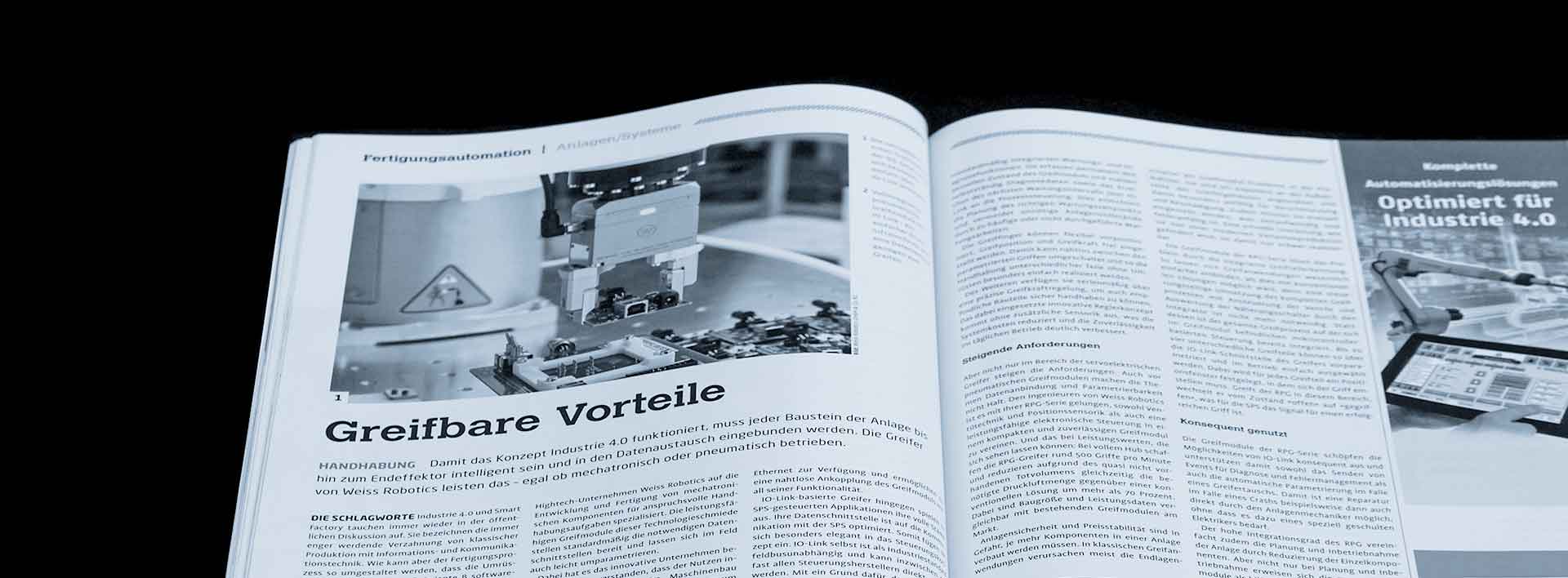
Hardly any description of modern manufacturing can do without the buzzwords ‘Industry 4.0’, ‘smart factory’ or ‘human-robot collaboration’. But it is not just the robot that must meet the requirements. For the concept to work, all components must also meet the requirements of modern production, which will become increasingly collaborative in the future.
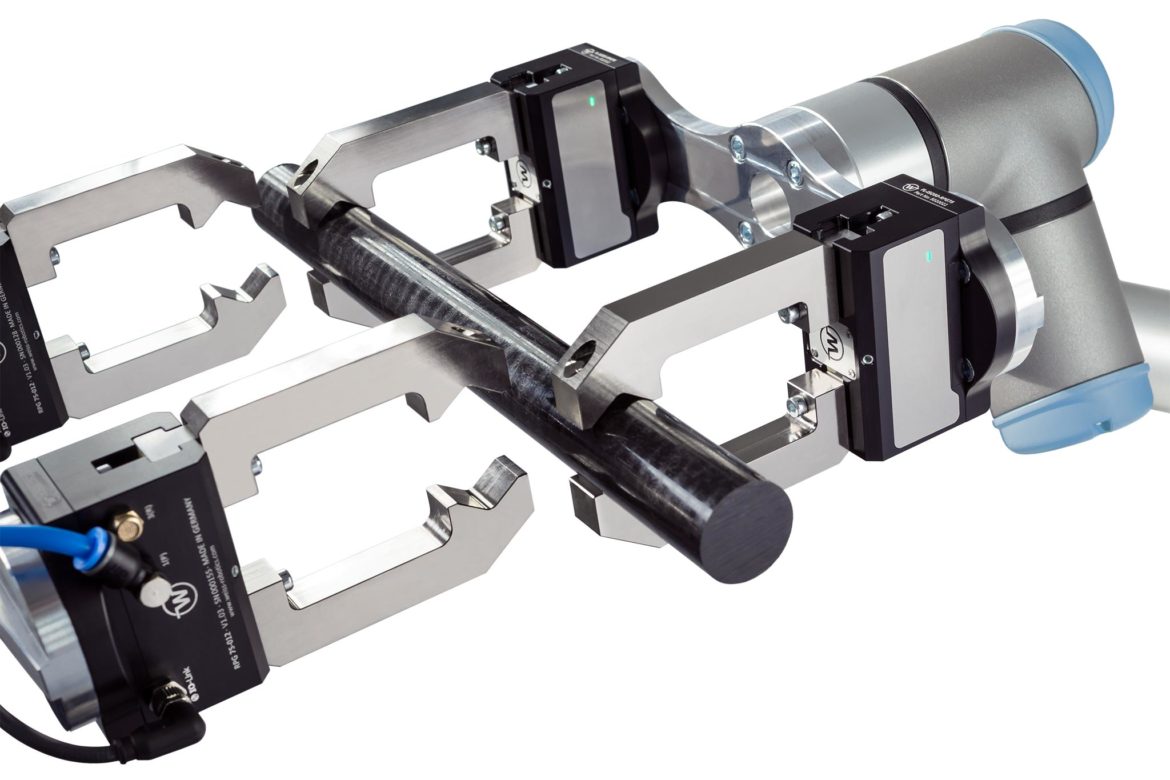
The aim of collaborative robotics is to combine the advantages of human labour with those of using robots, thereby achieving the best possible results in manufacturing. The field of human-robot collaboration brings together the best of both worlds. Human beings’ ability to learn, their experience and their capacity to improvise are combined in the most advantageous way with the strengths of a robot, such as accuracy, precision and reproducibility at high speed. The trend towards close and integrated collaboration, in which the working areas of humans and robots overlap, is leading to the gradual breakdown of the separation between robot workstations with safety fences and manual workstations. One of the most important issues and a key prerequisite for the implementation of cobots is the safety of ‘robot colleagues’. After all, it is of no use if only the robot is equipped with safety mechanisms, but not the gripper module as the end-effector. Specifically to meet these requirements, the Ludwigsburg-based high-tech company Weiss Robotics, which specialises in the development and manufacture of mechatronic components for demanding handling tasks, has designed a gripping module which, with its rounded edges and safely limited gripping force, represents a flexible tool for collaborative robots. The CRG 30 complies as standard with the DGUV recommendations for collaborative robot systems as well as the requirements of the ISO/TS 15066 standard, thereby significantly simplifying the mandatory risk assessment of the system in collaborative robot applications.
Collaboration and safety right from the integration stage with the robot
But that’s not all. The engineers at Weiss Robotics go one step further in implementing this concept. To optimise machine changeovers at the touch of a button and ensure quality assurance integrated into the manufacturing process for pick-and-place applications, they have designed the GRIPKIT in collaboration with the Danish lightweight robot manufacturer Universal Robots. This is where human-robot collaboration begins – right from the incredibly simple assembly of the gripper module and the intuitive set-up and programming of the grippers and the robot, even without any significant programming knowledge. This is because the Ludwigsburg-based gripping specialist’s industry-proven gripping modules integrate almost seamlessly into the robot arms from Universal Robots. There are currently six variants of GRIPKIT in total, covering a broad range of applications, including collaborative applications. GRIPKIT contains all the components required for the quick and easy implementation of a gripping application with Universal Robots. Starting with the flange adapter and the appropriate interface converter, the scope of delivery also includes the necessary cables, suitable mounting hardware and a USB stick containing documentation and the appropriate URCaps plug-in. This makes GRIPKIT a genuine plug-and-work solution.
Adaptive gripping technology as a prerequisite for Industry 4.0
Industry 4.0, another buzzword in today’s manufacturing sector, refers to the ever-closer integration of traditional production with information and communication technology. This integration is essential, as products must be tailored ever more individually to customer requirements, whilst being produced in even the smallest batch sizes with the greatest possible cost-effectiveness. In order for the manufacturing process to be redesigned in such a way that switching from variant A to variant B can be achieved via software – virtually at the touch of a button – the data connectivity of all active components involved in the process and their configurability at runtime must be guaranteed. This is because only end-to-end communication right down to the field level enables the process to be easily reconfigured, thereby facilitating economically viable automated variant production. The high-performance gripper modules from the Ludwigsburg-based technology firm provide the necessary data interfaces as standard and can also be easily re-parameterised in the field. Depending on the target application, Weiss Robotics’ gripper modules feature either Ethernet or IO-Link connectivity. With the help of IO-Link, the gripper fingers can be flexibly pre-positioned, and the gripping position and gripper force can be freely adjusted. This allows seamless switching between up to eight parameterised grips, making it particularly easy to handle different parts without time-consuming and costly changeovers.
Smart Grippers
Constant feedback on the current process provides reassurance and enhances the quality and reproducibility of the result. The CRG features a light ring which, through its various lighting patterns and colours, intuitively informs the user about the gripper’s current status. Even greater precision is achieved through the diagnostic data provided by the system for each gripper module. The high-resolution absolute measurement system reliably detects the finger position even without an initial reference run. Integrated gripper part recognition enables the reliable handling of complex workpieces, even in difficult situations. Thanks to sensorless gripper force control, even brittle, fragile or compliant parts can be gripped safely and reliably at all times. State-of-the-art model-based algorithms determine the current gripping force from the drive status and regulate it precisely to the specified value. This technology guarantees a reproducible gripping result even under changing environmental conditions.
Maximum system availability through integrated sensor technology
In conventional gripping applications, proximity switches on the gripping module are often the source of production problems. They are frequently positioned in exposed locations on the gripper housing and are therefore particularly susceptible to contamination, accidental misalignment and damage. Furthermore, they must be adjusted manually, which is time-consuming and prone to errors. For this reason, Weiss Robotics’ gripper modules feature integrated position sensors. This eliminates the need for external proximity switches and significantly improves process stability.
The process control system built into the gripper modules also enables continuous monitoring of the gripping process, right through to targeted fault-finding using diagnostic data provided by the components. Process-relevant parameters such as the gripping point and movement duration can be retrieved from the gripper module at any time. Analysing these values over time at the plant level provides insight into the ‘health’ of the handling process and enables service personnel to intervene at an early stage. This minimises unproductive plant downtime and increases the plant’s cost-effectiveness.
This illustrates how servo-electric gripping modules and smart pneumatic grippers deliver added value to plant operators by digitising the gripping process. In the day-to-day operation of a software-controlled production plant maintained according to actual needs, they are the core components and are what make the flexible automated production – often referred to under the terms Industry 4.0, HRC and Smart Factory – possible right down to batch size 1.