
The pioneering spirit lives on: from WSG to WPG
In 2008, WEISS ROBOTICS manufactured its first grippers in a three-room flat in Pflugfelden, Ludwigsburg. “The living room became an office, the children’s room a workshop. The electronics were assembled in the bedroom,” recalls founder and managing director Dr Karsten Weiß. It wasn’t long before there was no longer enough space. Even the second flat they rented could only alleviate the space problem for a short time. A new solution was needed. After just over a year of construction, the then 37-year-old opened his new site with its own production facilities in Oßweil, Ludwigsburg.
From the very beginning, one idea was central to this: gripping technology should be able to adapt flexibly to different tasks, and not the other way round.
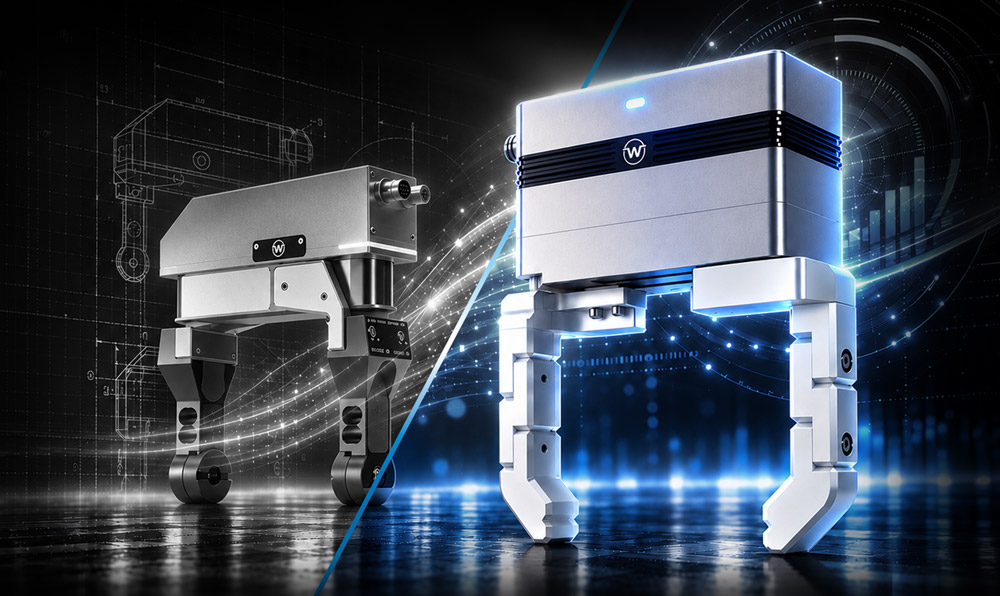
In 2009, the first WSG grippers were delivered. They helped shape the development of adaptive gripping for many years. Now a generational change is on the horizon: the WSG series is being phased out, whilst we are continuing its approach with the WPG series. The WPG series combines more than 15 years’ experience with new possibilities for modern robotic applications.
From the robotic hand to the two-finger gripper
The roots of the WSG series go back to Dr Karsten Weiß’s doctoral thesis at the Karlsruhe Institute of Technology (KIT). There, he worked on tactile sensor technology and a tactile multi-finger hand, which was later marketed under the name ‘SDH’ by a well-known clamping technology manufacturer. This gave rise to the question of how the principles of adaptive gripping could be applied to a two-finger gripper for practical automation tasks.
A key step was to make the gripping process digitally accessible. The WSG (Ethernet) could be controlled directly from PC-based applications via Ethernet. Sensory extensions provided additional information about contact with the workpiece: optional force-measuring fingers were able to measure the gripping force directly at the workpiece.
The architecture was deliberately designed to be open. This allowed the WSG to be integrated into various control concepts and provided scope for applications whose requirements could not even be foreseen at the time of its development.
How researchers utilised the WSG
The importance of this openness was particularly evident in robotics research. In 2023, Dr Karsten Weiß visited Columbia University in New York. There, the WSG 50 was used in the ‘DextAIRity’ research project. Direct control of the gripper from a PC via Ethernet was a key component of the experimental setup. On the visit to Columbia University
The project combined robot-assisted gripping and manipulation with strategically directed airflow, for example to unfold textiles or open bags. Such tasks are particularly challenging because the shape of the objects can change during movement.
This example illustrates just how intensively the research teams utilised the capabilities of the WSG. These experiences have sharpened our understanding of the freedoms developers will continue to require in the future.
The next step: WPG and Motion Stream Interface (MSI)
“We want to keep gripping technology adaptive,” says Dr Karsten Weiß, summarising the aim.
The WPG series takes this concept further. It offers Ethernet, sensorless gripping force control, integrated part detection and monitoring, and an IP54-rated control section. Via the integrated GRIPLINK protocol, it can be integrated into suitable robotic applications. About the WPG series.
The optional Motion Stream Interface (MSI) goes one step further: a higher-level controller can continuously specify movements and force limits to the WPG. The internal control loops implement these specifications as dynamic positioning. At the same time, the servo-electric gripper feeds back status data, including position, speed and estimated gripping force.
MSI thus opens up new possibilities for applications in the field of Physical AI. For example, an external system can analyse camera data and adjust the gripping movement whilst a process is underway. Perception, AI-based decisions and higher-level motion planning remain within the external system. MSI provides the interface to the gripping movement. More about MSI.
Which solution is right for the application?
For operators of existing WSG applications and for new systems, the question arises: which gripper is the right choice for the future?
For Ethernet-based robot and PC applications, the WPG series – a further development of the WSG – is the ideal choice. Where integration via a traditional fieldbus is required, the IEG PLUS series with an integrated IO-Link interface is a suitable option. Via a suitable IO-Link master, it can be integrated into various automation networks and traditional PLC environments.
The specific gripping task determines which solution is actually suitable: stroke, force range, gripper fingers, mechanical connection, sensor technology and control integration must all be compatible. As always, we provide personalised support to our customers and partners during the selection and technical evaluation process. Please do get in touch.
Discontinuation of the WSG series: the next steps
We no longer recommend the WSG series for new systems and designs. The WPG and IEG PLUS series offer modern alternatives, the suitability of which should be assessed on a case-by-case basis. The following order deadlines apply to the WSG models:
- WSG 32-068, item number 5120007: Last order date is 31 March 2027. Service will continue until the end of 2028.
- WSG 50-110, item number 5120008: Last chance to order by 31 December 2027.
With the discontinuation of the WSG series, a defining chapter in the product history of WEISS ROBOTICS comes to an end. We would like to express our special thanks to our customers and partners, who have repeatedly presented the WSG with new challenges through demanding applications; to the research teams who have explored its full potential; and to our staff who have designed, manufactured and supported it over many years.
Yet the pioneering spirit with which it all began lives on. With the WPG series, we are opening a new chapter in adaptive gripping. In doing so, we are relying on new technologies, new ideas and the same enthusiasm as on day one. Let’s continue writing this story together. Are you with us?