

Discover the future of gripping
As a leading specialist in mechatronic gripping systems, we have been developing and manufacturing smart servo grippers for the sensitive and precise handling of demanding gripping parts for assembly automation, the electronics and semiconductor industries and the life sciences sector since 2008.
Smart Grippers. Seamlessly Integrated.
At Weiss Robotics, the gripping system doesn’t stop at the robot flange. Our GRIPLINK technology offers a seamless and efficient integration of servo-electric grippers directly into your robotic application — for greater flexibility, easy commissioning, and maximum process reliability. Thanks to standardized interfaces and intuitive control, GRIPLINK® significantly reduces programming efforts and enables quick adaptation to changing production requirements. At the same time, direct communication between the robot and gripper ensures precise movements and reliable process monitoring. But GRIPLINK offers even more: Continuous real-time data collection enables in-depth analysis of gripping processes, supports deep learning applications, and provides valuable insights for process optimization. This creates the foundation for intelligent automation, increasing both efficiency and quality in your production over the long term.
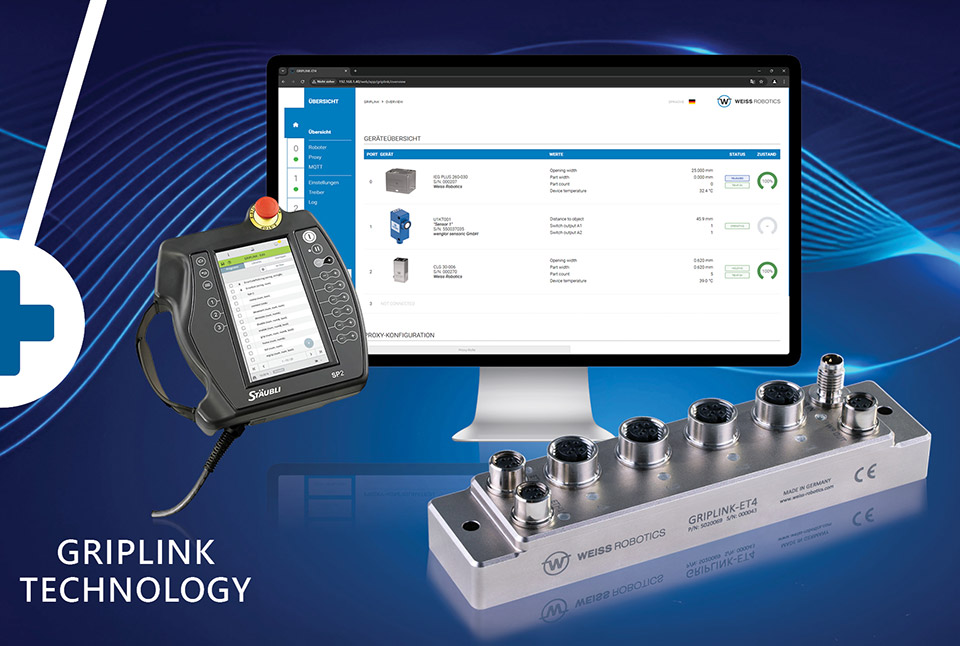

GRIP SMARTER
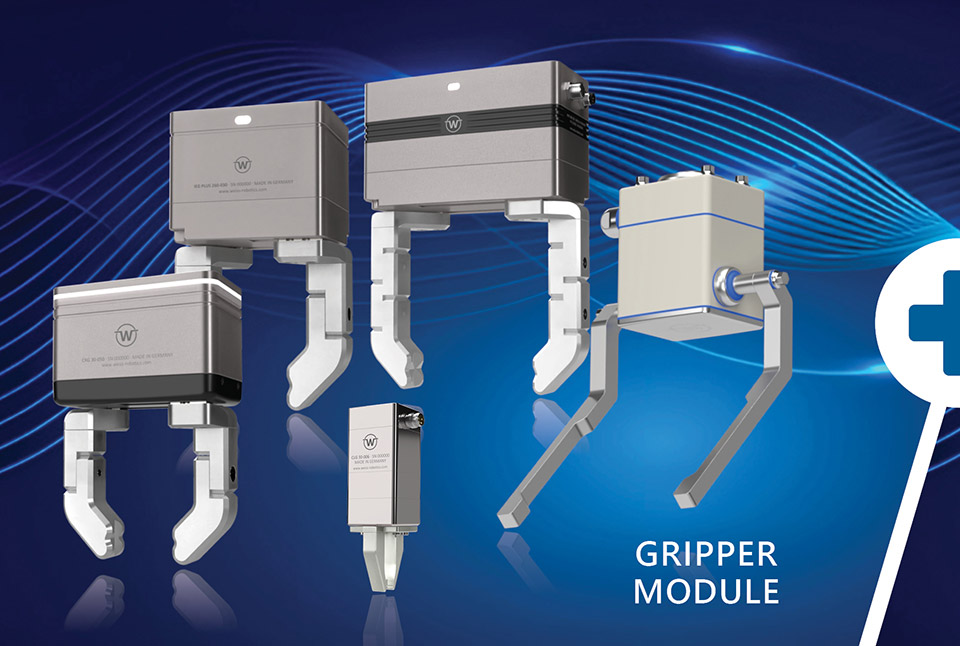
Smart gripping modules from Weiss Robotics with integrated workpiece recognition and grip monitoring optimize your gripping process and increase your productivity.

DIGITAL GRIPPING PROCESS
Gripping modules from Weiss Robotics with direct data connection take your gripping process to the next level. Always have your production under control.

EASY INTEGRATION
Reduce your engineering, assembly and maintenance costs by using smart gripping modules from Weiss Robotics. With integrated diagnostics as standard.

GRIP WITH ADDED VALUE
Extend your technological advantage with intelligent handling solutions from Weiss Robotics.

EXCELLENT CONSULTING
Weiss Robotics is the specialist for mechatronic handling solutions. Benefit from expert advice and first-class support from our specialists.

HIGHTECH MADE IN GERMANY
As an owner-managed company, Weiss Robotics develops and manufactures its products in Ludwigsburg, Swabia. Trust in premium quality directly from the manufacturer.
Current highlights
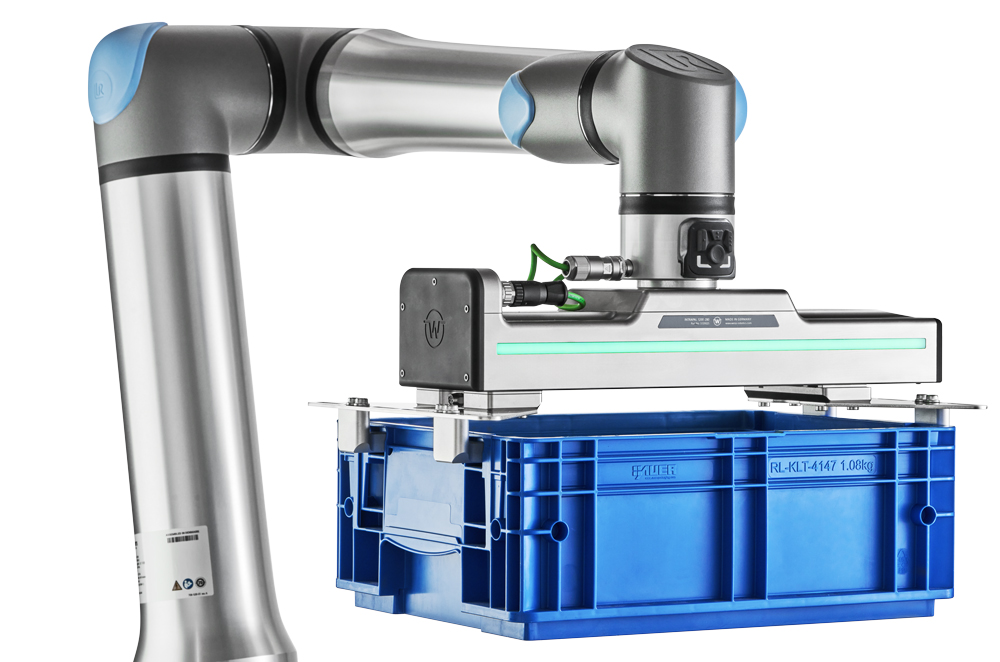
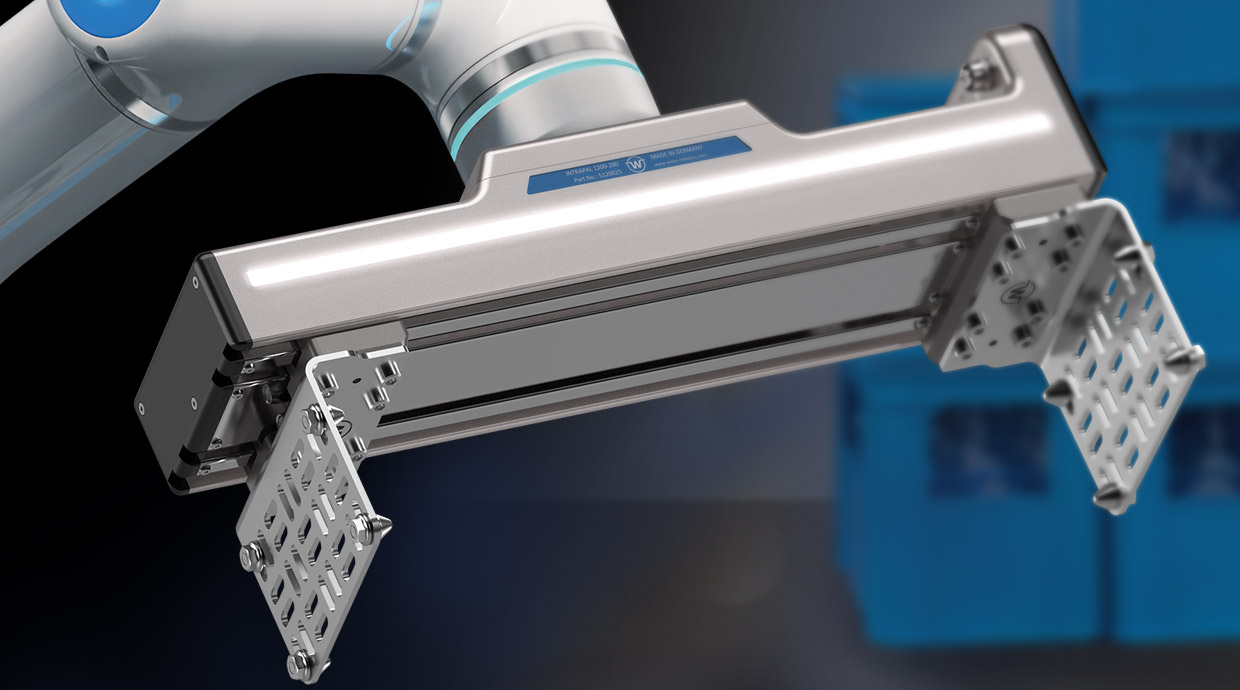
Next-Generation Palletizing: INTRAPAL for Universal Robots Gen 7
Palletizing operations increasingly need to handle a broad mix of cartons, crates, trays and load carriers – often with frequent format changes and different gripping requirements. Some of these items, such as storage bins and open-top corrugated trays used in food logistics, can be difficult to pick reliably with pneumatic vacuum systems: open or perforated containers cannot provide a reliable seal, structured surfaces may cause vacuum loss, and flexible packaging can be deformed or damaged by suction. Mechanical gripping can address these constraints, but conventional solutions may require manual adjustments or complete tool changes when product dimensions change.
End users and integrators therefore need a solution that can handle different formats reliably, apply only the required gripping force and adapt through software rather than mechanical retooling.
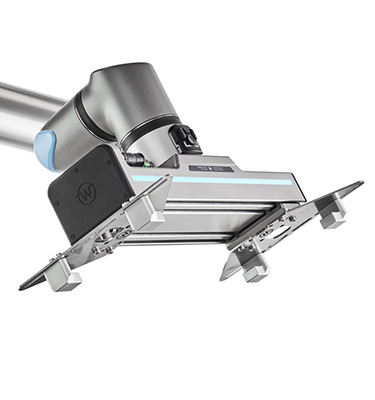
Our INTRAPAL servo-electric palletizing gripper is designed precisely for these applications, providing reliable, force-controlled handling across changing products and formats.
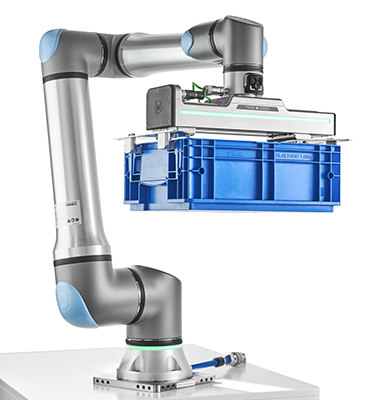
With our new URCapX integration, INTRAPAL can be configured, programmed and controlled directly in PolyScope X. On Universal Robots Gen 7 platform, Ethernet at the tool flange also enables a short, streamlined connection at the end of the arm, reducing external cabling and supporting flexible intralogistics applications.
Manufacturers benefit from direct gripper control in PolyScope X, high-power connectivity at the g-Series tool flange, and greater flexibility when handling demanding palletizing and intralogistics applications.
The Solution
INTRAPAL was developed for precisely this kind of flexibility. It combines servo-electric actuation with a 280 mm stroke, a freely pre-positionable moving finger and an adjustable gripping force of 150 to 1,200 N. This allows one gripper to handle a wide range of cartons, open-top corrugated trays, beverage crates and KLT containers without changing the gripper.
Integrated part detection and continuous grip monitoring provide feedback from pick to place. INTRAPAL is rated for workpieces weighing up to 60 kg with form-fit gripping or up to 30 kg with friction-fit gripping. The permissible payload in an application depends on the complete robot and tool configuration.
Our new URCapX Plugin makes INTRAPAL’s functions directly available in PolyScope X, allowing users to configure, program and control the gripper from the robot interface. INTRAPAL supports Ethernet TCP/IP as standard. On Gen 7, the short Ethernet connection and power supply at the new tool flange keeps cabling short and avoids routing a long communication cable along the robot arm. Alternatively, optional Modbus RTU enables operation through the robot’s Tool I/O.
The g-Series high-power tool flange allows INTRAPAL to operate at full gripping force directly from the robot, supporting secure handling of larger load carriers in palletizing workflows. Users also benefit from the new SP7 Smart Panel and its intuitive interface, which brings teaching and programming directly at the tool flange.
For applications requiring additional functionality at the gripping point, INTRAPAL’s integrated IO-Link interfaces allow compatible third-party sensors and actuators, such as distance sensors, to be connected directly to the gripper fingers. These are then controlled via the GRIPLINK® ecosystem in PolyScope X.
Results
For end users, the immediate benefit is a cleaner end-of-arm installation and a more direct commissioning workflow. Instead of mechanically exchanging the complete gripper for every new format, users can adjust the finger position, gripping force and process parameters in the robot program.
Fewer external components and shorter cable paths simplify the installation, while integrated part detection and continuous grip monitoring make the gripping process more transparent. The result is an adaptable palletizing solution designed for frequent format changes, reliable operation and future expansion.
“With Gen 7, Universal Robots has created the connectivity and payload headroom to support demanding intralogistics applications. Together with our new URCapX integration, INTRAPAL can be connected directly at the tool flange and operated in PolyScope X, making powerful palletizing solutions easier to integrate and adapt.”
- Dr. Karsten Weiss, Founder and CEO, WEISS ROBOTICS
Universal Robots Gen 7
Universal Robots (UR), the original collaborative industrial robot manufacturer and part of Teradyne Robotics, introduced Gen 7, its seventh-generation robotics platform anchored by the PolyScope X robot operating system. Built for the next generation of automation, Gen 7 expands connectivity between robots, software, sensors, vision systems and end effectors, helping manufacturers deploy more capable applications with less integration effort.
Redesigned from tool flange to controller, the new Gen 7 robot platform is AI-ready by design, giving manufacturers unrivaled compute, connectivity and open architecture to deploy AI models directly on production robots without a performance trade-off.
What's new in Gen 7?
- New g-Series robot arms: UR10g-1750, UR17g-1300, and UR18g-950, joining the e-Series and UR Series lineup.
- AI-ready tool flange: Delivers data, high-power and safety directly to the tool flange, making it easier to connect cameras, sensors, grippers and other peripherals while reducing cabling complexity.
- New SP7 Smart Panel, for teaching and programming directly at the tool flange.
- CB7 Core controller: 40% more compute in a 30% smaller footprint, enabling multi-network communication with PLCs, HMIs, MES platforms, IPCs, and vision systems while reducing the need for external switches.
- PolyScope X software platform: Brings modern programming tools with open APIs for building and deploying edge-AI applications using IPCs and external AI processing, along with ISO 10218-1:2025 safety functionality and cybersecurity compliance.
- Redesigned TP7 Core teach pendant for improved ergonomics and faster programming.
- Built-in safety and cybersecurity: All g-Series robots are TÜV certified to ISO 10218-1 and UL1740, while Teradyne Robotics is certified to IEC 62443-4-1 ML3 for secure software development practices
Ecosystem
Gen 7 is backed by the UR+ ecosystem, a curated, rigorously tested portfolio of automation products, each validated by UR before reaching market.
“What our partners are doing is exactly the kind of proof point that demonstrates the formative power of UR´s open platform and quality ecosystem. They are taking advantage of the advanced connectivity features on our Gen 7's platform and build on it to provide easy-to-integrate products that run on the floor today.”
- Susanne Nördinger, Head of Ecosystem Success EMEA
Why This Matters
For manufacturers in food and beverage, production logistics, warehousing and other high-mix environments, product formats and material-flow requirements can change quickly. Combining INTRAPAL with Universal Robots Gen 7 provides a flexible, software-configurable approach to palletizing and material handling—without requiring a separate gripper for every format.
Customers gain an integrated gripping process that is easier to deploy, easier to monitor and ready to grow with future automation requirements.
Explore INTRAPAL’s technical specifications, applications and available downloads on the INTRAPAL product page and download the INTRAPAL leaflet here.
Planning a palletizing or intralogistics application with Universal Robots Gen 7? Contact WEISS ROBOTICS to discuss your workpieces, payload requirements and the right finger configuration for your application.
ABOUT WEISS ROBOTICS
WEISS ROBOTICS develops and manufactures smart servo-electric grippers for demanding automation tasks. The owner-managed family business based in Ludwigsburg, Germany, serves customers and partners worldwide. Its solutions are used in electronics manufacturing, assembly automation, pharmaceutical and life science applications and intralogistics.
Its grippers combine precision and flexibility with finely adjustable gripping force. The GRIPLINK® ecosystem enables Plug & Produce through tested robot plug-ins, standardised interfaces and unified commands, reducing integration and commissioning effort.
Intelligent control, integrated sensing and real-time process data enable efficient, reliable gripping processes, consistent quality and continuous monitoring, diagnostics and optimisation – key capabilities for Physical AI. WEISS ROBOTICS combines pioneering innovation with reliable “Made in Germany” quality, long-term thinking and personal service.
Celine Weiß, Marketing Manager Partner & Events, c.weiss@weiss-robotics.com
ABOUT UNIVERSAL ROBOTS
Universal Robots is a global leader incollaborative industrial robots (cobots). With over 100,000 cobots sold worldwide, the company's user-friendly platform is supported by intuitive PolyScope software, award-winning training, comprehensive services, and the world's best cobot ecosystem, delivering innovation and choice to customers across a wide range of industries. With the most advanced robots in their class and a growing catalogue of ready-to-deploy AI applications, UR's latest technology is built for the physical AI revolution.
Universal Robots is part of Teradyne Robotics, a division of Teradyne Inc. (NASDAQ:TER), a leading supplier of automated test equipment and advanced robotics systems.
Nilufar Moosavi, Product Marketing Manager for Physical AI & Ecosystem, nims@universal-robots.com
Read more … Next-Generation Palletizing: INTRAPAL for Universal Robots Gen 7
Cognitive Robot Manipulation
How can robots independently perform complex tasks in real-world environments? This is the question being explored by the AICOR Institute for Artificial Intelligence (IAI) at the University of Bremen, headed by Prof. Dr. h.c. Michael Beetz.The research focuses on robotic systems that can perceive their environment, plan actions and make decisions autonomously. Instead of simply executing pre-programmed motion sequences, these systems are designed to respond flexibly to different situations – both in household and industrial environments.
A key prerequisite for this is reliable interaction with the physical world. This is exactly where gripping technology comes into play. Malte Huerkamp, Research Associate at the IAI, describes its importance as follows: “Without a reliable gripping system, neither tools can be operated nor objects handled, which blocks any further research progress.”
Flexible gripping technology for demanding research scenarios
For the experimental setups at the IAI, a gripping system was required that is precise, durable and flexible to use. The decision was made in favor of gripping modules from WEISS Robotics.
The grippers are currently being used in experiments for cutting fruit and vegetables – a subtask of automated meal preparation. Tasks like these clearly demonstrate how demanding robotic manipulation is in real-world scenarios: different objects, tools and materials require flexible solutions at the robot arm.
One important advantage is the ability to individually design and replace the gripper fingers. The team around Prof. Dr. h.c. Michael Beetz explains: “This allows us to use the same gripper for different tools and objects without having to change the entire system every time.”
Easy integration into existing robot platforms
In addition to mechanical flexibility, integration into the existing laboratory environment also played an important role. At the IAI, the gripping systems are used in combination with UR5 robots.
The software integration was also straightforward. The researchers report: “Thanks to the supplied ROS2 and Python interfaces, the gripping system could be quickly integrated into our existing system landscape without major integration effort.”
This enabled the grippers to be integrated quickly into the existing research environment and used for various experiments.
Professional gripping technology for research, teaching and student projects
The gripping systems have now become an integral part of the robot platforms at the IAI. As a result, they are used not only in research projects, but also in courses, project work, and bachelor’s and master’s theses.
For students, this provides direct access to professional gripping technology and realistic application scenarios. Working with the systems connects theoretical knowledge with practical robotics experience and supports the development of technical skills for their future careers.
Precise gripping systems as a key component for robots as everyday assistants
One central research focus in the coming years will be on manipulation tasks that enable robots to become reliable and largely autonomous assistants in everyday life. These include applications such as meal preparation or loading and unloading dishwashers.
For such scenarios to be not only planned but actually carried out, gripping systems are needed that are precise, reliable and flexible to integrate. This is exactly where the gripping systems from WEISS Robotics make a decisive contribution: they combine mechanical precision with adaptable gripper fingers and suitable interfaces for integration into modern robot platforms.
Looking to the future, the team at the AICOR Institute writes: “In the coming years, the trend will continue toward robots increasingly working together with humans and performing complex tasks based on natural-language instructions.”
We are pleased that gripping systems from WEISS Robotics are supporting the research work at the AICOR Institute for Artificial Intelligence at the University of Bremen and that we are contributing to the next generation of cognitive robotic systems.
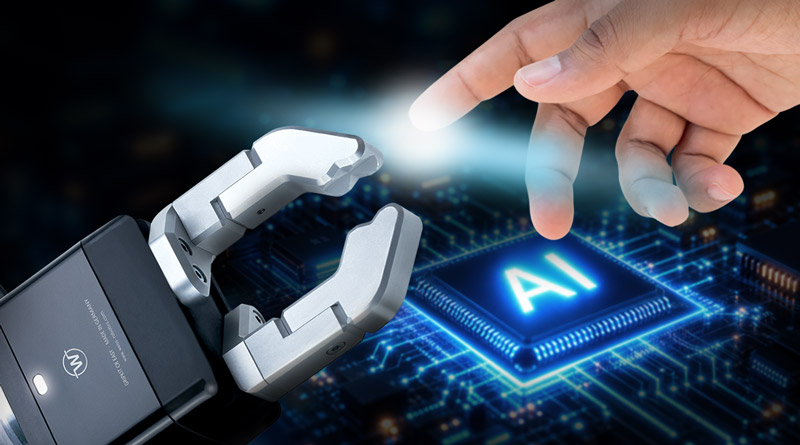
Motion Stream Interface – Physical AI Starts Here
Real-time motion streaming for adaptive robotics, teleoperation, and AI-driven manipulation.
Physical AI is fundamentally changing robotics. Instead of relying solely on pre-programmed motions, robots are increasingly acting on sensor data, AI models, and real-time decisions. To respond dynamically to their environment, they need direct access to their actuators with minimal latency and continuous feedback. This is exactly where the Motion Stream Interface (MSI) from Weiss Robotics comes in.
MSI extends selected servo grippers with a powerful real-time streaming interface. External controllers, AI systems, or teleoperation solutions can continuously transmit position and force setpoints to the gripper as a motion stream while simultaneously evaluating feedback data in real time. This transforms the gripper into an integral component of modern control architectures and Physical AI systems.
For machine builders, system integrators, and automation teams, the challenge is increasingly how to connect intelligent software with real-world manipulation tasks. While AI systems can plan motions, detect objects, and make decisions, direct real-time access to the end effector is often missing. MSI closes this gap by enabling continuous gripper control from external systems — ranging from vision-based applications and custom control algorithms to advanced Physical AI frameworks.
Typical application areas include:
- Physical AI & Advanced Bin Picking
Adaptive gripping motions for AI-based robotics, complex part scenarios, and advanced bin-picking applications. - Teleoperation & Remote Manipulation
Transmit, mirror, and integrate gripper movements in real time across remote systems. - External Gripper Control & Research
Direct real-time access for custom control algorithms, prototypes, and research applications.
With MSI, companies can build the foundation for robotic applications that are no longer limited to predefined motion sequences. Instead, adaptive systems can react to changing conditions, learn from data, and continuously adjust their actions in real time. The gripper becomes an active interface between artificial intelligence and physical interaction.
Read more … Motion Stream Interface – Physical AI Starts Here

Product catalog
Discover our wide range of products! Download our current product catalog to get a comprehensive overview of our range.